The 3 Stages of Intelligence: From Asking Questions to Changing the World
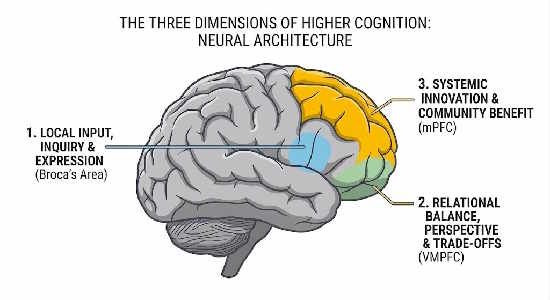
True intelligence is far more than a single IQ score or raw mental processing power. When we look closely at how the human brain processes reality, higher cognition reveals itself as an integrated system - one that moves sequentially from local articulation to relational balance, and ultimately to systemic, collective vision.
By examining key neural processing hubs - Broca's Area, Wernicke's Area, the Ventromedial Prefrontal Cortex (VMPFC), Brodmann Area 10 (BA 10), and the Fronto-Parietal Control Network - we can trace the complete blueprint of how human beings comprehend, evaluate, and transform the world around them.
1. The Foundation: Meaning and Articulation
Before an idea can be evaluated or shared, it must first be comprehended and structured.
- Wernicke's Area & The Temporal Lobe (Comprehension & Universal Insight): Located in the posterior temporal region, Wernicke's area acts as the brain's primary decoder of meaning. Supported by the surrounding temporal cortex - which processes long-term memory, holistic visual pattern recognition, and contextual depth - this region synthesizes raw input into direct, coherent understanding. It is where complex reality is distilled into foundational truth.
- Broca's Area (Local Execution & Syntax): Connected to Wernicke's area via the arcuate fasciculus neural highway, Broca's area in the frontal lobe takes those synthesized concepts and constructs them into sequential grammar, clear logic, and immediate speech. It is the engine of day-to-day expression and immediate communication.
2. The Three Dimensions of Higher Executive Cognition
Once basic meaning is established and expressed, higher cognitive processing relies on three distinct prefrontal networks to operate at increasing levels of scale:
Local Input & Expression | Broca's Area & Medial BA 10
Functional Role: Manages local syntax, linear rules, immediate verbal exchange, and active learning from one's immediate environment, powered by Medial BA 10's core epistemic drive.
Relational Evaluation & Comparative Logic | VMPFC & Medial BA 10
Functional Role: Serves as the brain's valuation hub - weighing competing perspectives, evaluating counterarguments, and balancing emotional values with objective facts to execute true critical judgment while modeling opposing theoretical frameworks dispassionately.
Global & Community Impact | Fronto-Parietal Control Network (Lateral BA 10 + Posterior Parietal Cortex)
Functional Role: Processes macro-level networks, group dynamics, community impact, and solutions that benefit the collective whole. Led by Lateral BA 10 as master meta-controller, the Fronto-Parietal Control Network detaches from individual self-interest entirely - applying abstract rules and systems thinking impersonally across the collective.
From Local Learning to World-Changing Ideas: Scaling Human Intelligence
True cognitive brilliance isn't static hardware - it is a dynamic, step-by-step engine of discovery that transforms raw curiosity into systemic innovation. When we examine higher cognition, intelligence naturally evolves across three distinct dimensions:
- Local Interaction & Curiosity (Broca's Area & Medial BA 10): Intelligence begins with curiosity as its spark. Curiosity isn't passive; it requires actively framing questions, seeking immediate environmental input, mastering rules, and breaking the world down into symbols and logic to ask "Why?" and "How?" Driven by this innate desire to learn, Broca’s area serves as the active motor of local learning, data acquisition, and sequential articulation. While Broca’s area manages the verbal expression of these questions, this epistemic drive originates in Medial Brodmann Area 10 (BA 10), which detects fundamental knowledge gaps and sparks raw abstract curiosity.
- Relational Balance & Comparative Evaluation (VMPFC): Intelligence matures when it moves from gathering raw data to evaluating complex value. Acting as the brain’s valuation hub, the Ventromedial Prefrontal Cortex enables critical thinking by stepping outside personal bias - weighing counterarguments, balancing emotional values with objective facts, and holding another person's perspective to achieve nuanced, objective judgment. Operating alongside the VMPFC, Medial BA 10 provides the neural canvas required to dispassionately model another person's theoretical framework without emotional bias.
- Systemic Innovation (Fronto-Parietal Control Network): Peak cognitive maturity occurs when an individual synthesizes local facts and relational balance to think beyond established boundaries. The Fronto-Parietal Control Network enables out-of-the-box, macro-level thinking - designing original theories, solutions, or innovations that transform and serve the broader community. At the peak of this circuit sits Lateral BA 10, acting as the master meta-controller that synthesizes these abstract insights into prospective, long-range innovations designed for the collective benefit of mankind.
Conclusion: Integrated Intelligence
When evaluating intellectual capability, we cannot rely on narrow measures of processing speed alone. True cognitive brilliance requires a seamless bridge between deep temporal comprehension, precise local expression, balanced relational evaluation, and broad systemic vision.
When all these neural centers operate in harmony - moving from initial curiosity to relational balance and mass innovation - human intelligence rises above mere data processing to achieve genuine wisdom and lasting impact.