Not Having Hope Is Denying the Miracles of Divine Nature
We often treat hope as a mood, but neuroscience reveals it as the primary driver of physical life. It is not a passive emotion - it is one of the strongest biological predictors of whether a person lives or gives up.
Decades of research, beginning with Aaron Beck, found something striking: it is not sadness that most predicts suicide, it is hopelessness. A person can be profoundly depressed and survive; but when hope collapses, the risk climbs sharply. Hopelessness, not sorrow, is the deadliest symptom.
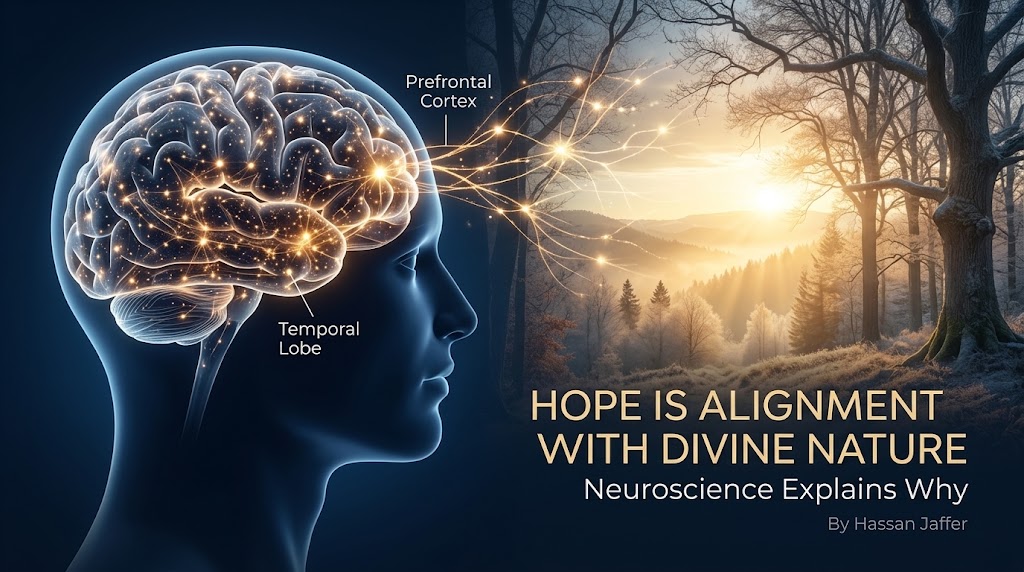
Why should losing a feeling be so lethal? Because hope is not a feeling at all. It is the mind's ability to project a future worth living. Neuroscience is beginning to locate it: the temporal regions that hold meaning and higher truth, and the circuits that let us imagine tomorrow. When those go dark, the future disappears, and without a future there is nothing to walk toward.
"To lose hope is to deny the Miracles of Divine Nature"
Look at how existence is built. Night always turns to dawn. Winter always breaks into spring. Wounds close, tides return, what looks finished renews. This is not sentiment; it is the observable law of nature. Despair makes one claim, and only one: "the pattern cannot change for me." But Divine Nature answers, in everything it does, that the pattern always changes. To insist otherwise is to deny the miracle we are surrounded by.
That is why the world's wisdom traditions treat despair not as weakness but almost as a trespass. To abandon hope is to say the renewal built into creation does not apply to you. And that is never true.
So hope is not soft, and it is not optional. Restoring it, through meaning, faith, connection, or simply reminding a person that the pattern turns, is not a nicety. It may be the single most protective thing we can offer another human being.
There is also a way to guard against the dark before it ever falls. The two systems that despair switches off can be kept lit by simple daily means, and both are within anyone's reach.
Keep the hippocampus and the sense of emotional security alive through bonds: a family, children, even a pet. Something that depends on you, and that you belong to, anchors you in the present and gives the brain a living reason to project a tomorrow.
Keep the temporal lobe alive through prayer, or any form of spirituality: the practice that reaches for meaning and higher truth. It exercises the very region where meaning is held, and keeps the door to the future open.
These are not last resorts for a crisis. They are daily maintenance for the circuits of hope, a quiet pre-emptive safeguard, long before anyone needs to be pulled back.
If you know someone in the dark, do not only try to lift their sadness. Try to return their future. Remind them that nature has never once run out of dawns.
Hope is alignment with Divine Nature. And Divine Nature never stops renewing.
The Neuroscience Beneath This
Everything above has a physical basis in the brain, and the research is more precise than most people realise.
First, the claim that hopelessness - not sadness - predicts suicide is not rhetorical. It is one of the most replicated findings in psychiatry. In a landmark ten-year prospective study, Aaron Beck and colleagues found that the degree of hopelessness, measured years in advance, predicted eventual suicide far better than the severity of depression itself (Beck, Steer, Kovacs & Garrison, 1985). Sorrow is painful; the loss of a future is what turns lethal.
Second, hope is not a mood but a capacity - the brain's ability to construct a future and stand inside it. Remembering the past and imagining the future run on the same neural machinery: a network linking the hippocampus, prefrontal cortex, and midline default-mode regions (Schacter, Addis & Buckner, 2007). This is the circuitry that lets a person picture a tomorrow worth walking toward. When it dims, the future literally stops being generated, and there is nothing left to move toward.
Third, meaning itself has an address. The anterior temporal lobes act as a semantic hub - the brain's convergence zone, where concepts, significance, and higher-order meaning are bound together (Patterson, Nestor & Rogers, 2007). It is no accident that these same temporal regions surface repeatedly in the neuroscience of depression and suicidal states. When the seat of meaning quietens, the world does not simply feel sad - it stops meaning anything, which is a different and more dangerous darkness.
Put together, the picture is coherent. Despair is the collapse of two systems at once: the system that generates a future (prospection) and the system that holds meaning (the temporal semantic hub). That is why restoring hope is not sentimentality. Reintroducing meaning, connection, and a credible tomorrow is, in the most literal sense, switching those circuits back on.
This also points to prevention. Bonds and caregiving - a family, children, a pet - engage the hippocampal and limbic systems of attachment and emotional security, the same systems that buffer the brain against stress. Prayer and contemplative practice engage the temporal and frontal regions where meaning is processed. Exercising these circuits in ordinary life is, in effect, keeping the machinery of hope in condition, so that it holds when it is tested.
The philosophy above and the neurology here are the same statement in two languages. Nature is built to renew - dawn after night, spring after winter - and the human brain is built to perceive and lean on exactly that renewal. To restore someone's hope is to reconnect them to the pattern that both the mind and the world are made to follow.
Beck, A. T., Steer, R. A., Kovacs, M., & Garrison, B. (1985). Hopelessness and eventual suicide: A 10-year prospective study of patients hospitalized with suicidal ideation. American Journal of Psychiatry, 142(5), 559-563.
Patterson, K., Nestor, P. J., & Rogers, T. T. (2007). Where do you know what you know? The representation of semantic knowledge in the human brain. Nature Reviews Neuroscience, 8(12), 976-987.
Schacter, D. L., Addis, D. R., & Buckner, R. L. (2007). Remembering the past to imagine the future: The prospective brain. Nature Reviews Neuroscience, 8(9), 657-661.
Read and discuss this article on LinkedIn.