Life Could Not Have Started on Earth
The numbers do not work.
The Mathematical Barrier
Fred Hoyle calculated the probability of a single functional set of proteins assembling by chance from raw amino acids at 1 in 10 to the power of 40,000. He famously compared it to a tornado sweeping through a junkyard and assembling a Boeing 747. That mathematical hurdle has never been refuted - only rationalized away.
The Time Window
Earth formed 4.54 billion years ago. After the late heavy bombardment cooled, complex biosignatures appear in the fossil record almost instantly in geological terms. The window between a molten planet and the first evidence of life is under 200 million years. Unguided molecular trial and error does not work that fast.
The Evidence From Deep Space
Now the physical evidence from deep space has caught up with the math.
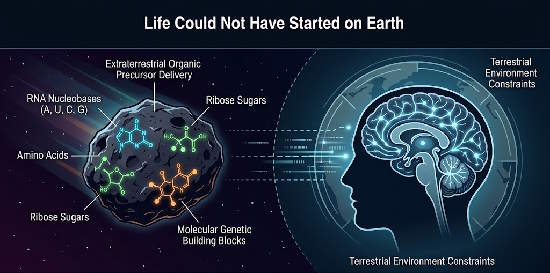
NASA and JAXA analysis of samples returned from the Ryugu asteroid confirmed nucleobases - specifically uracil, one of the four essential letters of the RNA alphabet - embedded in a 4.5 billion year old rock from deep space. This means that the nucleobases were already encoded in space matter before Earth was even habitable. The DNA alphabet existed in space when Earth was still a lava ball.
Both the Ryugu asteroid and Earth are 4.5 billion years old. The difference is that the asteroid was never subjected to molten conditions, bombardment, or geological disruption. The nucleobases survived intact. Earth would have destroyed them.
Panspermia Is No Longer Fringe
This moves panspermia - long championed by Hoyle and Chandra Wickramasinghe - out of fringe hypothesis and into observable astrobiology. Asteroids and comets are not random debris; they are delivery mechanisms carrying an already encoded biological alphabet.
The Logical Conclusion
The design of life predates Earth entirely.
If the molecular alphabet required to construct biological software was already embedded in space matter billions of years ago, the architecture is pre-planetary, pre-existing, and structural. It is not local. It is not accidental. It is pre-programmed into the fabric of matter itself.
The question science continues to bypass is not whether design exists - the probability calculations, the sudden fossil record appearance, and the Ryugu astrochemistry all point to the same baseline reality.
The real question is: what fundamental architecture embeds the operating system of life into matter before a single planet exists to run it?