The Brain Audits Itself Six Times Before You Act
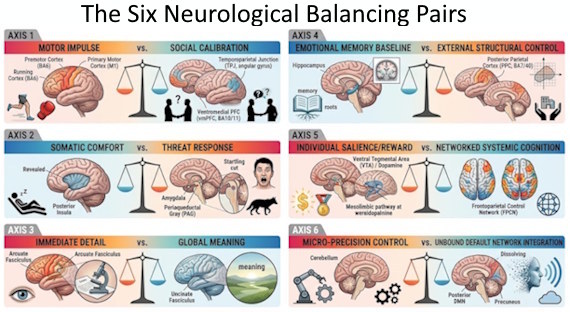
While contemporary neuroscience routinely documents anti-correlated, antagonistic network axes to explain macro-level push-pull equilibrium in the brain - and frequently examines adjacent neural pathways in isolation as localized micro-circuits - it currently lacks a unified model connecting these sequential transitions.
By formalizing these contiguous handoffs into Six Balancing Pairs, we can bridge the gap between static structural architecture and real-time operational processing. Rather than viewing adjacent brain regions as isolated neighbors that sporadically communicate, this framework establishes an obligatory processing pipeline.
Every drive generated by a node is immediately audited and constrained by its adjacent counterpart before advancing to downstream execution. This step-by-step audit is what transforms raw neural activation into structured behavior.
6 Contiguous Balancing Pairs
1. Initiation ↔ Consolidation (Domains 1 and 2)
Anterior DMN and Motor/Premotor Cortex hands off to the Basal Ganglia, Ventral Striatum, and Posterior Insula/Hypothalamus.
The mechanism: Self-referential motor drive hands off to procedural habit-locking, metabolic tracking, and homeostatic baseline.
2. Articulation ↔ Integration (Domains 3 and 4)
Broca's Area and Perisylvian Language Network hands off to the Hippocampus and Subcortical Limbic Roots.
The mechanism: Linear symbolic encoding and motor syntax are audited and absorbed by autobiographical memory and emotional-attachment roots.
3. Generation ↔ Discrimination (Domains 5 and 6)
VTA/NAcc hands off to the OFC (and Cerebellum/Dorsal Attention Network).
The mechanism: Dopaminergic drive and creative projection pass into an error-monitoring, quality-control, and value-refinement filter.
4. Deliberation ↔ Commitment (Domains 7 and 8)
vmPFC and Theory of Mind/TPJ hands off to the Extended Amygdala and Periaqueductal Gray (PAG).
The mechanism: Open-ended valuation and multi-perspective deliberation hand off to a visceral, survival-level commitment that breaks deliberation paralysis.
5. Synthesis ↔ Executive Architecture (Domains 9 and 10)
Temporal Pole, Angular Gyrus, and Uncinate hands off to the Posterior Parietal Cortex (PPC, BA 7/40) and Frontopolar Cortex.
The mechanism: Macro-level conceptual synthesis and pattern recognition are constrained into long-term goal sequencing and structural architecture.
6. Systemic Abstraction ↔ Subconscious Dissolution (Domains 11 and 12)
Frontoparietal Control Network (FPCN) and dmPFC hands off to the Posterior DMN (PCC and Precuneus) and Salience Network (Anterior Insula).
The mechanism: Impersonal, rule-based systems logic yields to ego-container deactivation, non-focused awareness, and subconscious integration.
The Macro-Level Equilibrium: 6 Antagonistic Pairs
Where the contiguous pairs define the sequential regulatory pipeline, the following opposing pairs establish the macro-level equilibrium that prevents network over-dominance:
- Axis 1 (Motor Impulse vs. Social Calibration): Impulse to Act (Premotor/Primary Motor) ↔ Social Calibration (vmPFC/TPJ)
- Axis 2 (Somatic Comfort vs. Threat Processing): Somatic Comfort (Posterior Insula) ↔ Threat Response (Amygdala/PAG)
- Axis 3 (Local Detail vs. Global Meaning): Immediate Detail (Arcuate Fasciculus) ↔ Big-Picture Meaning (Uncinate Fasciculus)
- Axis 4 (Internal Memory Baseline vs. External Spatial/Structural Control): Emotional Memory and Roots (Hippocampus) ↔ External Structure (Posterior Parietal)
- Axis 5 (Individual Salience/Reward vs. Networked Systemic Cognition): Individual Center (VTA/Dopamine) ↔ Systemic Network (Frontoparietal Network)
- Axis 6 (Micro-Precision Control vs. Unbound Default Network Integration): Micro-Precision (Cerebellum) ↔ Boundless Integration (Posterior DMN/Precuneus)
At the center of this entire cross sits the DLPFC - acting not as a specific domain, but as the central will and executive hub navigating these transitions.
This 12-domain Neurofunctional sequence links static network topology directly to real-time decision-making cascades. By mapping the exact biological operating system, we can observe how the brain natively balances excitation and inhibition, dopamine and serotonin, and personal drive versus systemic regulation.
Regulation vs. Opposition: A Necessary Correction
Neuroscience routinely classifies certain network pairs as antagonistic or opposing. Two of these classifications require correction.
The vmPFC does not oppose the amygdala - it regulates it. Top-down inhibition during fear extinction is a governance signal, not a conflict between equal forces. One region audits and constrains the next.
Similarly, the habenula does not oppose VTA dopamine - it enforces the OFC's quality-control verdict. When reward expectations fail, the OFC signals the habenula to suppress dopamine output. That is a sequential regulatory handoff, not opposition.
Calling these pairs antagonistic misrepresents the mechanism. The brain does not fight itself. It audits itself - which is precisely what the Six Balancing Pairs formalize.
I welcome thoughts and peer review from those working in network neuroscience, cognitive health, and psychiatry.